AI Nutritionist vs Human Nutritionist: Which Is Actually Worth Your Money in 2026?
Let's be honest: most of us know we should eat better. The question isn't what — it's how, and more to the point, who can actually help you get there without costing a fortune or requiring a degree in biochemistry.
The rise of AI nutrition coaching has created a genuine question: do you still need a human nutritionist? Or has the technology finally caught up to the point where an app can do the job just as well?
This article gives you an honest, balanced answer — no hype, no agenda.
What Does a Human Nutritionist Actually Do?
A registered dietitian or nutritionist (the terms vary by country and qualification level) typically offers:
- A detailed intake assessment of your current diet, health history, and goals
- Personalised meal plans based on your specific needs
- Ongoing support, accountability, and plan adjustments
- Expertise in clinical nutrition for complex conditions (diabetes, kidney disease, eating disorders, cancer support)
- Interpretation of blood work and medical data
- Behavioural coaching to help you build sustainable habits
A good human nutritionist brings something no algorithm currently replicates perfectly: clinical judgement honed by years of training and experience with diverse patients.
What Can an AI Nutritionist Do?
AI nutrition platforms like Nutrify AI offer a growing suite of capabilities:
- Instant meal analysis via photo scanning — point your camera at a plate and get calories, macros, and micronutrients in seconds
- 24/7 availability — ask a nutrition question at 11pm on a Sunday and get an evidence-based answer immediately
- Personalised recommendations that adapt based on your logged data, goals, and progress
- Pattern recognition — spotting trends in your eating habits that even you might not notice
- Meal planning and recipe suggestions based on what's in your pantry
- Habit tracking and reminders to keep you consistent
- Integration with workouts, sleep, and stress data for a holistic picture
And then there's features like Roast My Plate — where AI gives your meal an honest (and often hilarious) critique. It's a surprisingly effective way to get a reality check on your eating habits without the awkwardness of confessing your McDonald's order to a real professional.
The Honest Cost Comparison
Human Nutritionist Costs (UK/US Average 2026)
| Service | Cost |
|---|---|
| Initial consultation (60–90 min) | £80–£200 / $100–$250 |
| Follow-up sessions | £50–£120 / $70–$150 |
| Monthly programme | £200–£500 / $250–$600 |
| NHS/insurance covered | Varies; often limited to clinical conditions |
AI Nutrition App Costs
| Tier | Cost |
|---|---|
| Free tier (e.g. Nutrify AI) | £0 |
| Premium subscription | £5–£20 / $7–$25 per month |
| Annual plan (discounted) | £40–£150 / $50–$200 per year |
The maths is stark. One session with a human nutritionist costs the equivalent of 6–24 months of an AI app subscription.
For most people trying to eat healthier, lose weight, build muscle, or improve their energy levels, that cost difference is hard to justify — especially when AI apps are now genuinely good at the everyday guidance tasks.
Head-to-Head: The Key Factors
Personalisation
Human nutritionist: Deep personalisation based on a detailed assessment. A good dietitian will ask about your food culture, family situation, cooking skills, budget, and psychological relationship with food. They pick up on things you didn't think to mention.
AI nutritionist: Increasingly sophisticated. Apps like Nutrify AI adapt recommendations based on your logged data, goals, and feedback. The personalisation gets better the more you use it. However, it starts from what you tell it — it can't read between the lines the way a human can.
Winner: Humans, but the gap is narrowing.
Availability and Convenience
Human nutritionist: Appointments, waiting lists, fixed hours. If you have a question at 7am before a big meeting or at 10pm when you're staring into the fridge, you're on your own.
AI nutritionist: Always on. Always patient. Never judges you for asking the same question three times. Answers in seconds.
Winner: AI, decisively.
Accuracy and Evidence Base
Human nutritionist: A qualified dietitian has years of university training, clinical placements, and continuing professional development. They stay current with nutrition science and can apply nuanced judgement.
AI nutritionist: AI models are trained on enormous datasets and are generally accurate for mainstream nutrition guidance. However, they can occasionally confidently state outdated or oversimplified advice. Always cross-reference anything that sounds unusual.
Winner: Humans for clinical accuracy; AI is excellent for general guidance.
Accountability and Motivation
Human nutritionist: Knowing you have an appointment next Tuesday is a powerful motivator. The human relationship — disappointment, encouragement, genuine care — is hard to replicate.
AI nutritionist: AI apps are getting better at accountability through streaks, reminders, and community features. But a notification isn't quite the same as a person asking 'how did the meal prep go this week?'
Winner: Humans, though AI community features are closing the gap.
Complex Medical Conditions
Human nutritionist: Essential. For conditions like chronic kidney disease, cancer, severe eating disorders, or complex metabolic disorders, registered dietitians are a critical part of the healthcare team.
AI nutritionist: Not appropriate as a standalone solution for complex medical nutrition needs. A good AI app will recognise this and direct you to seek professional help.
Winner: Humans, no contest.
So When Should You Choose Each?
Choose an AI Nutrition App When You:
- Want to build generally healthier eating habits
- Are trying to lose weight, gain muscle, or improve energy
- Want 24/7 access to nutrition guidance
- Have a limited budget
- Are tracking macros, calories, or specific nutrients
- Want meal ideas based on what's in your fridge
- Are curious about the nutritional content of your meals
- Want a fun, honest assessment of your food choices (hello, Roast My Plate)
Choose a Human Nutritionist When You:
- Have a complex medical condition affecting your nutrition
- Are recovering from an eating disorder
- Are pregnant or breastfeeding with complications
- Need clinical-level dietary management for a disease
- Have repeatedly struggled with AI or self-guided approaches and need human support
- Want to combine medical nutrition therapy with general healthy eating
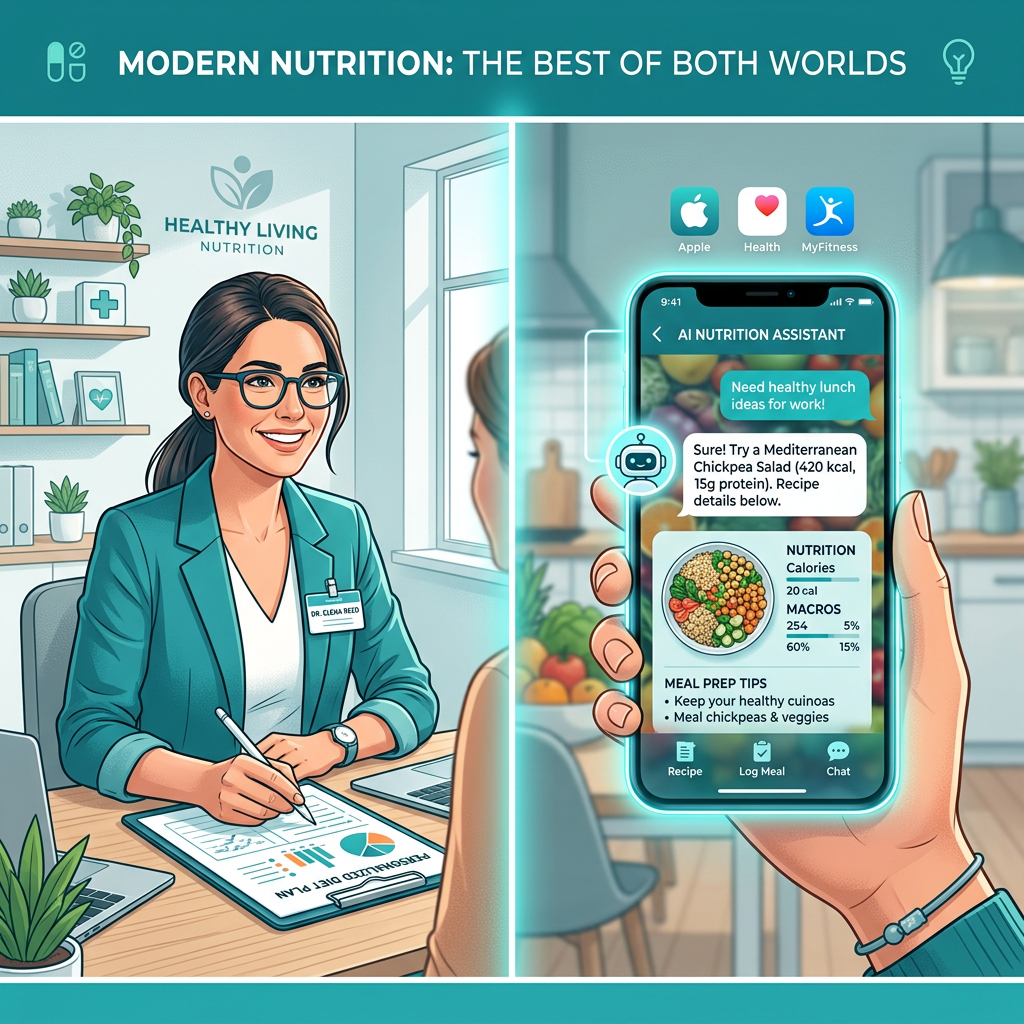
The Best of Both Worlds
For most people, the ideal scenario is using an AI nutrition app for daily guidance and logging, with occasional check-ins with a human nutritionist for accountability and clinical oversight. This gives you affordability, convenience, and depth.
The Future: Will AI Replace Human Nutritionists?
Not entirely — and probably not soon. The clinical, emotional, and relational aspects of human nutrition counselling have real value that AI can't replicate. But for the 95% of people whose nutrition goals are 'eat better, feel better, look better' rather than managing a complex medical condition, AI is already a highly capable, accessible, and affordable solution.
The trajectory is clear: AI nutrition tools will keep improving, becoming more accurate, more personalised, and more integrated with your broader health data. The best ones, like Nutrify AI, are being built with this future in mind from day one.
Frequently Asked Questions
Is AI nutrition advice safe to follow?
For general healthy eating guidance, yes. AI nutrition apps draw on established dietary science and are generally safe for healthy adults. If you have a medical condition, always consult a qualified healthcare professional before making significant dietary changes.
Can an AI app help me lose weight?
Absolutely — many users find AI-assisted calorie and macro tracking more effective than unassisted dieting, because the data feedback is immediate and objective. Consistency is key, and features like habit tracking and meal reminders help significantly.
How accurate is AI meal scanning?
Modern AI meal scanners (like the one in Nutrify AI) are surprisingly accurate for common foods and meals. They improve with use as you confirm or correct estimates. For unusual dishes or very precise medical tracking, manual logging may still be preferable.
What qualifications should a human nutritionist have?
In the UK, look for a Registered Dietitian (RD) registered with the HCPC, or a Registered Nutritionist (RNutr) registered with the AfN. In the US, look for a Registered Dietitian Nutritionist (RDN). Be cautious of 'nutritionists' without recognised qualifications.
Is Nutrify AI free to use?
Nutrify AI offers a free tier with generous limits, plus premium plans for unlimited access. Join the waitlist at nutrify.info to be among the first to try it.
Ready to Transform Your Nutrition with AI?
Join the Nutrify AI waitlist at nutrify.info and try Roast My Plate at nutrify.info/roast-my-plate — because the first step to eating better is knowing what you're actually eating.
Back to Blog | Home | Privacy Policy | Terms of Service