Traditional nutrition tracking demands time, effort, and constant vigilance that busy professionals and parents simply don't have. Logging every meal, counting calories, and decoding nutritional labels quickly becomes overwhelming. AI-powered nutrition platforms are changing this by analysing your dietary habits, health data, and personal goals to deliver tailored recommendations without the complexity.
This guide covers how AI makes personalised nutrition accessible, the proven health benefits backed by research, practical tools you can use today, and important limitations to keep in mind.
Key Takeaways
| Point | Details |
|---|---|
| Personalised AI nutrition | AI analyses biomarkers, genetics, gut microbiome, and daily intake to tailor dietary recommendations for each individual. |
| Real-time guidance | AI integrates wearable data, lab results, and food diaries to update recommendations daily. |
| Health benefits evidence | Meta-analyses and clinical trials show AI nutrition guidance outperforms traditional counselling and improves long-term adherence. |
| Expert oversight needed | Best results come from combining AI tools with professional guidance. |
How AI personalises nutrition
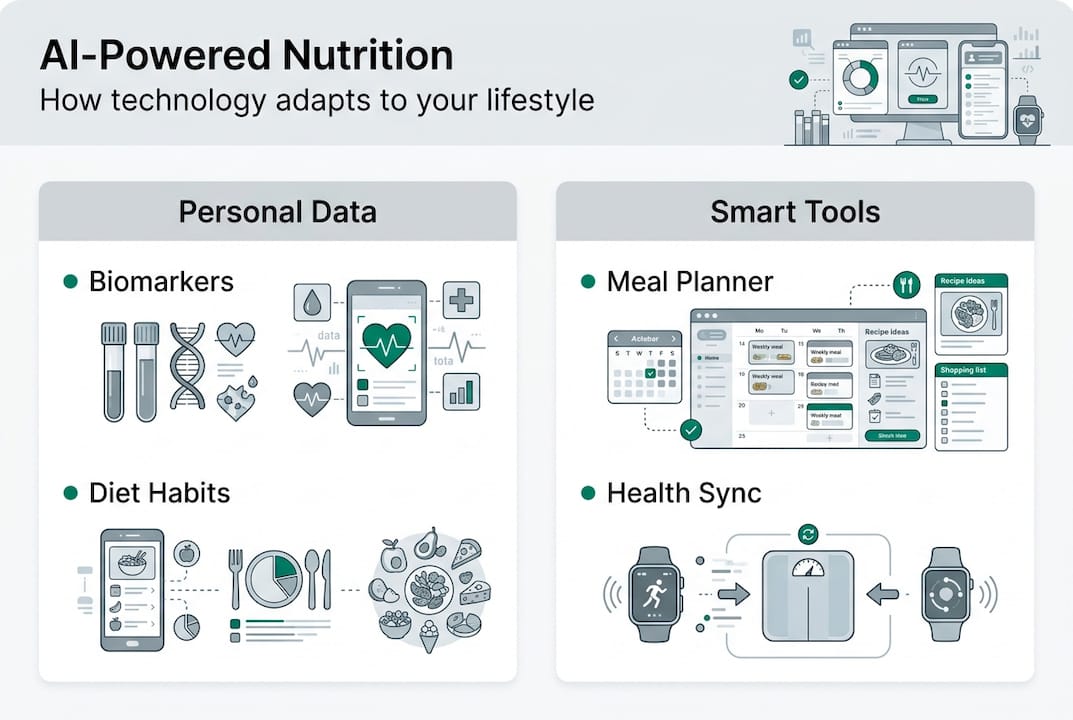
AI processes large amounts of personal health data to create customised dietary recommendations. Machine learning algorithms analyse your biomarkers (measurable indicators like blood sugar or cholesterol), genetic information, gut microbiome composition, and daily food intake to identify patterns that traditional methods miss.
The technology behind AI nutrition relies on several sophisticated techniques. Variational auto-encoders and gradient boosting models improve the accuracy of nutrient predictions and forecast glycemic responses to different meals. Deep learning networks continuously refine recommendations based on your feedback and progress, making the system more useful over time.
AI platforms bring together multiple data sources to deliver real-time guidance:
- Wearable device metrics tracking activity levels, sleep quality, and heart rate variability
- Laboratory results showing vitamin deficiencies, inflammation markers, or metabolic health
- Food diary entries captured through photos, voice commands, or manual logging
- Health goals ranging from weight management to managing chronic conditions
This comprehensive approach lets AI spot connections between diet and health outcomes that would take a human nutritionist weeks to identify. The system adapts daily based on your changing needs, stress levels, exercise intensity, and food availability. Nutrify AI brings this together by combining nutrition analysis with training plans and wellness support in one platform.
Pro tip: Feed your AI nutrition app consistent data for at least two weeks before judging it. The algorithms need that baseline to recognise your patterns and deliver genuinely personalised recommendations rather than generic advice.
Research demonstrates that this personalised approach yields better adherence and health outcomes compared to one-size-fits-all dietary guidelines.
Proven health benefits of AI-driven nutrition
Empirical studies show significant health improvements when people use AI-powered nutrition guidance. Meta-analyses examining thousands of participants show that AI interventions outperform traditional dietary counselling across multiple health markers.
| Health condition | AI intervention outcome | Comparison to traditional methods |
|---|---|---|
| Irritable bowel syndrome | Symptom reduction in 73% of participants | 15–20% better than standard dietary advice |
| Type 2 diabetes | Remission achieved in 41% of cases | 12% higher remission rate |
| High cholesterol | Average 18% reduction in LDL levels | 8% greater reduction |
| Overall diet quality | 23% improvement in adherence scores | Significantly exceeds conventional approaches |
Clinical trials show that AI nutrition platforms help users maintain dietary changes longer than traditional programmes. The convenience factor matters enormously — it's far easier to snap a photo of a meal than to manually calculate macronutrients. That reduced friction translates directly into better compliance and sustained health improvements.
"AI dietary interventions show statistically significant improvements in dietary quality and adherence compared to traditional nutritional counselling, with effect sizes ranging from 0.3 to 0.7 standard deviations across multiple health outcomes."
The benefits go beyond calorie counting. AI systems identify micronutrient deficiencies that contribute to fatigue, poor immune function, and chronic inflammation. Addressing these hidden gaps leads to better energy and overall wellness.
For parents, AI tools provide age-appropriate meal suggestions that meet the whole family's needs without preparing separate dishes. Evidence from systematic reviews confirms that families using AI nutrition guidance report less mealtime stress and better dietary variety for children.
Practical AI nutrition tools for busy people
Modern AI nutrition apps turn food tracking into something that actually fits a hectic schedule. They're built around the reality that busy professionals and parents need solutions that work in seconds.
The most useful features in today's AI nutrition tools include:
Photo-based meal logging. Point your camera at a meal and the app identifies the food, estimates portions, and calculates your macros in seconds. No searching databases, no manual entry.
Barcode scanning. For packaged foods, a quick scan pulls the full nutritional profile instantly.
Smart meal planning. The AI generates weekly meal plans based on your goals, preferences, and available time — adjusting automatically when your week changes.
On-demand coaching. Ask questions about your diet, your progress, or what to eat before a workout and get an answer tailored to your data — not a generic response.
Wearable integration. Sync with your fitness tracker or smartwatch so your nutrition targets update based on actual activity, not estimates.
For busy parents, the ability to quickly scan a supermarket product and see whether it fits the family's nutritional needs is genuinely time-saving. The same technology that helps elite athletes optimise performance is now accessible and practical for everyday use.
Nutrify AI combines all of these features in one app — including GPS fitness tracking, habit building, and mental wellbeing tools — which removes the need to switch between multiple platforms.
Limitations and when to seek professional guidance
AI nutrition tools are powerful, but they work best when used with realistic expectations and, when appropriate, alongside professional input.
Data quality matters. The accuracy of AI recommendations depends entirely on the quality of the data you provide. Inconsistent logging, inaccurate portion estimates, or skipping days all reduce the system's ability to give useful advice.
AI cannot replace clinical assessment. If you have a diagnosed health condition — type 2 diabetes, kidney disease, disordered eating, or a complex food allergy — a registered dietitian should be involved in your care. AI can support and track, but it isn't a substitute for clinical judgement.
Individual variation is real. Two people following the same AI-generated meal plan may respond quite differently based on their gut microbiome, medication use, stress levels, and metabolic health. Use the app's data as a guide, not a rigid prescription.
Privacy considerations. AI nutrition apps process sensitive personal health data. It's worth reviewing the privacy policy of any app before sharing biometric or medical information.
Used thoughtfully, AI nutrition tools offer a meaningful upgrade over trying to manage health through willpower and rough estimates alone. The research consistently shows better outcomes — particularly for people who previously found traditional tracking too time-consuming to maintain.
Nutrify AI: personalised nutrition built for real life
Nutrify AI was designed specifically for people who want to improve their health without it becoming a second job. The app combines photo meal logging, macro tracking, personalised coaching, fitness planning, habit tracking, and mental wellbeing tools in one place.
For busy professionals and families, that consolidation matters. Instead of managing five separate apps that don't talk to each other, everything is connected — so your nutrition targets update when your activity changes, and your coach can see the full picture when you ask for advice.
The Nutrify AI blog has more on how different users — from runners to people managing their weight — are using the app to build sustainable habits.
Frequently asked questions
How accurate is AI-based meal recognition from photos?
Modern AI meal recognition is accurate enough to be genuinely useful, typically within 10–20% of the actual caloric value for most common foods. Accuracy improves with better photos and consistent use as the system learns your preferences. For most people, this level of precision is more than sufficient to support meaningful dietary improvements.
Can AI nutrition apps help with specific dietary requirements?
Yes. Most AI nutrition apps accommodate a wide range of dietary requirements including vegetarian, vegan, gluten-free, keto, and various allergies. The AI adjusts meal recommendations and nutritional targets based on your stated restrictions and preferences.
How long before I see results from using an AI nutrition app?
Most people notice improvements in their awareness of eating habits within the first two weeks. Meaningful health changes — better energy, improved digestion, weight changes — typically become apparent after four to eight weeks of consistent use. The key word is consistent: sporadic use produces sporadic results.
Is AI nutrition tracking suitable for children?
Some platforms include features designed for family use, but nutritional guidance for children should always involve a paediatrician or registered dietitian. Children have different nutritional requirements and it's important those are met correctly during development.
What makes AI nutrition different from a standard calorie counter?
A calorie counter gives you a number. An AI nutrition platform gives you context — connecting that number to your activity, sleep, stress, goals, and trends over time. It can identify patterns you'd never spot manually and give you advice specific to your situation rather than a generic target.
Does Nutrify AI work without a fitness wearable?
Yes. Nutrify AI works fully without a connected wearable. The app uses the activity and lifestyle data you provide directly. If you do connect a wearable, the recommendations become more precise — but it isn't a requirement to get real value from the app.